
Toggle clamp holding capacity: how to choose the right rating
Holding capacity, clamping force, units: how to read the rating shown on a product page and choose a toggle clamp suited to your application.
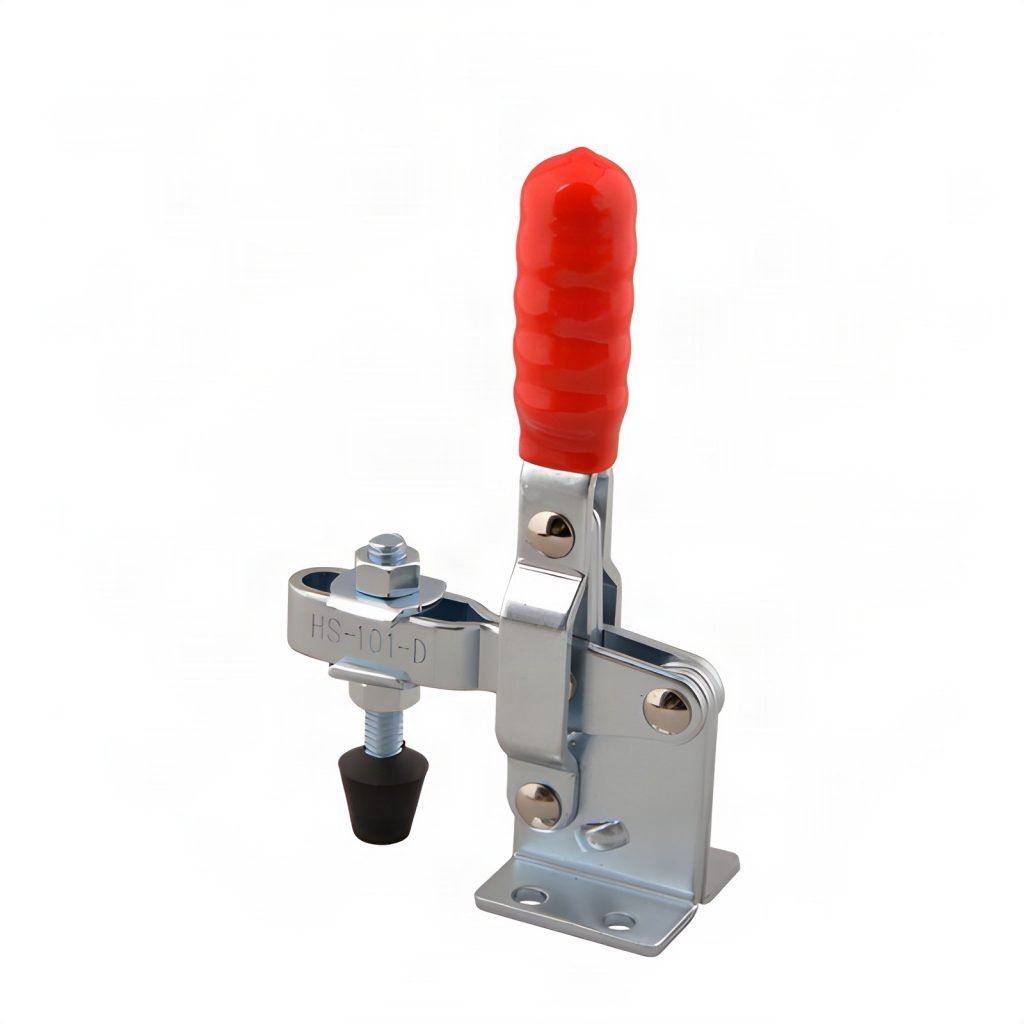
To choose a toggle clamp, you need to compare the force the workpiece will exert during the operation with the holding capacity of the model. This guide explains how holding capacity differs from clamping force, how to read the units (N, daN, kgf), which factors change the actual load and how to choose the capacity for your application. It does not replace a proper design study when the application is critical.
Holding capacity and clamping force: two different things
Holding capacity
The holding capacity is listed in the specifications of every GOGO INDUSTRY model, in kg. For example, the 101-D vertical toggle clamp is listed with a holding capacity of 180 kg. On its own, this value does not guarantee that the model suits every application: it must be read together with the actual operating conditions.
Manufacturers who document it give similar definitions. According to DESTACO, holding capacity is the maximum force that may be applied to the holding bar in the closed position without permanent deformation of the clamp components; the ratings are determined by actual tests, include a safety factor and should not be exceeded [1]. Carr Lane defines it as the maximum force the clamp can safely resist in its locked position without permanent deformation [2]. These definitions describe those manufacturers’ products; they are not a specification of GOGO INDUSTRY models.
Clamping force
Clamping force is the force actually applied to the workpiece when the clamp is closed and locked. For a manually operated clamp, it depends on the force the operator applies to the handle, where that force is applied, the mechanical advantage of the linkage and the point on the arm where it is measured [1]. Carr Lane adds that it is usually lower than the stated holding capacity, which leaves the clamp enough capacity to resist external forces, such as machining forces [2].
The load your fixture must withstand
The load to be withstood depends on the application: cutting forces, thrust, impacts, vibration and the direction of the force. It is estimated from the actual conditions at the workstation and the geometry of the fixture, not from the clamp model. If in doubt, have the design checked by a qualified person.
Holding capacity is not a lifting capacity. A toggle clamp holds a workpiece in position on a fixture. A holding capacity of 180 kg does not mean the clamp can lift, suspend or carry a 180 kg load: a toggle clamp must never be used as a lifting accessory.
N, daN, kgf: reading and converting the units
Force is measured in newtons (N), the SI unit. In the workshop, the decanewton (1 daN = 10 N) and the kilogram-force (1 kgf = 9.81 N, roughly 1 daN) are also used. The kilogram (kg) is a unit of mass: when a force is expressed “in kg”, kilograms-force are meant by convention.
GOGO INDUSTRY product pages list the holding capacity in kg, as supplied for the catalogue. If this value follows the kilogram-force convention, the conversion is as follows:
| Listed capacity | In newtons (× 9.81) | In decanewtons |
|---|---|---|
| 20 kg | ≈ 196 N | ≈ 19.6 daN |
| 180 kg | ≈ 1,765 N | ≈ 176.5 daN |
| 636 kg | ≈ 6,237 N | ≈ 623.7 daN |
| 2,500 kg | ≈ 24,517 N | ≈ 2,451.7 daN |
If your load is calculated in N or daN, convert it before comparing it with the product page, and only compare like with like (holding capacity with holding capacity). For an accurate design, ask us to confirm what the listed value covers for the model you are considering.
What affects the required force?
The operation and the forces on the workpiece
The load depends on the operation: cutting forces in machining, heat-related stresses in welding, thrust or impacts in assembly, simple positioning in inspection. The mass, shape and material of the workpiece also matter, as does the direction in which the force acts.
Where the clamp bears on the arm
Manufacturers who document it state that holding capacity is highest closest to the base and decreases as the spindle moves towards the end of the arm [1][2]. GOGO INDUSTRY product pages give one value per model without detailing this variation: if your fixture places the clamping point far from the base or uses an extension, ask us before choosing.
Spindle, supports and duty cycle
According to Carr Lane, an uncushioned hex-head spindle provides the greatest clamping force, and spindle position, spindle-height adjustment and the workpiece material also affect it [2]. The quality of the supports and how the clamp is fastened to its base matter too. The duty cycle and the working environment (spatter, corrosion) also guide the choice of model and material.
Choosing the capacity for your application
| Application | What loads the clamp | Points to check |
|---|---|---|
| Welding, jigs | holding in position, heat expansion | repeatability, spatter, access to the weld |
| Machining, drilling | cutting forces, vibration | direction of the force relative to the arm, rigid supports |
| Assembly, press-fitting | thrust, impacts | load peaks, duty cycle |
| Quality inspection | simple positioning | repeatability rather than high capacity |
| Closing and holding lids or hatches | pulling force on the latch | latch model, latch adjustment |
The GOGO INDUSTRY catalogue covers holding capacities from 20 to 3,400 kg depending on the model (catalogue data as of 16 November 2026). Ranges by family:
| Family | Listed capacities | Example models |
|---|---|---|
| Vertical toggle clamps | 30 to 550 kg | 13009: 30 kg · 101-D: 180 kg |
| Horizontal toggle clamps | 20 to 636 kg | 20100: 20 kg · 204-GL: 636 kg |
| Push-pull toggle clamps | 45 to 2,500 kg | 32500HL-A: 2,500 kg |
| Latch toggle clamps | 163 to 3,400 kg | 40360-ST: 3,400 kg |
| Pneumatic toggle clamps | 45 to 1,136 kg | 36330-A: 1,136 kg |
These are catalogue values; they do not guarantee suitability for a given application. The “Holding capacity” filter on the family pages helps you shortlist models.
How to determine the right capacity in 5 steps
- Estimate the load to be withstood: magnitude, direction and possible peaks, based on the actual conditions at the workstation. If the estimate is uncertain, have it checked by a manufacturing engineer or a design office.
- Read the holding capacity listed for the model you are considering, with its unit.
- Compare the estimated load, converted into the same unit, with the listed capacity. This comparison is a first indication, not a validation. Avoid a model whose capacity is close to the estimated load, and have the choice confirmed when the margin is small or the application is critical.
- Take the operating conditions into account: clamping point on the arm, extension, spindle, impacts, duty cycle.
- Do not confuse clamping force with holding capacity: GOGO INDUSTRY product pages list the holding capacity, not the clamping force. Depending on the nature and direction of the forces, deciding which value governs the hold is part of the design: have it checked if in doubt.
This guide gives neither a formula nor a safety factor: a reliable calculation depends on model-specific data (where the capacity is measured, arm geometry) that is not shown on the product pages.
Mistakes to avoid
- Confusing holding capacity with clamping force: clamping force is usually lower [2] and depends on the operator [1].
- Using a toggle clamp as a lifting accessory: holding capacity is not a lifting load.
- Comparing values in different units: convert N, daN and kgf before comparing.
- Reading the rating without considering the clamping point: for manufacturers who document it, it decreases towards the end of the arm [1][2].
- Working at the limit of the listed capacity: DESTACO presents its ratings as maximums that should not be exceeded [1].
- Estimating the load without the actual workstation conditions: duty cycle, impacts, heat and direction of the force change the requirement.
Technical FAQ
Are holding capacity and clamping force the same thing?
No. Holding capacity is the force the closed clamp can withstand; clamping force is the force it actually applies to the workpiece when it closes. Clamping force is usually lower [2].
Can a 180 kg toggle clamp lift a 180 kg load?
No. Holding capacity describes how the closed clamp holds on a fixture. It is not a lifting capacity, and a toggle clamp must not be used to lift or suspend a load.
How do I convert a capacity in kg into newtons?
If the value follows the kilogram-force convention, multiply it by 9.81: 180 kg is about 1,765 N, or about 176.5 daN. For an accurate design, ask us to confirm for the model concerned.
What margin should I leave between the estimated load and the capacity?
There is no factor that fits every application. Avoid working close to the listed capacity, especially with impacts, vibration or a clamping point at the end of the arm, and have the choice checked for a critical application.
Does the capacity change with the spindle position on the arm?
For manufacturers who document it, yes: it is highest near the base and lower at the end of the arm [1][2]. As our product pages give one value per model, contact us if your clamping point is far from the base.
How much clamping force can be applied by hand?
It depends on the operator and the mechanism [1]. For its own models, Carr Lane states that in most cases roughly half of the stated holding capacity can be applied by hand with medium effort [2]. This is not a specification for GOGO INDUSTRY models.
Need help choosing the right capacity?
Tell us the operation, the estimated load, its direction and the planned clamping point: we will help you identify the models whose holding capacity is suitable, with a price quoted for your quantities. Request a quote (reply within 24 working hours) or contact us.
You can also browse the full toggle clamp catalogue.
Further reading:
- How to choose an industrial toggle clamp
- Understanding the different types of toggle clamps
- Choosing the right toggle clamp accessories
Sources
[1] DESTACO, “How To Calculate Exerting Force, Clamping Force & Holding Capacity” — https://www.destaco.com/resources/blogs-and-insights/how-to-calculate-exerting-force-clamping-force–holding-capacity (accessed 16 November 2026).
[2] Carr Lane Manufacturing, “Holding Capacity & Clamping Force” — https://www.carrlane.com/engineering-resources/technical-information/manual-workholding/how-do-toggle-clamps-work/holding-capacity-clamping-force (accessed 16 November 2026).
Need help choosing?
Browse the catalogue or tell us about your application: we reply within 24 working hours.
Read also
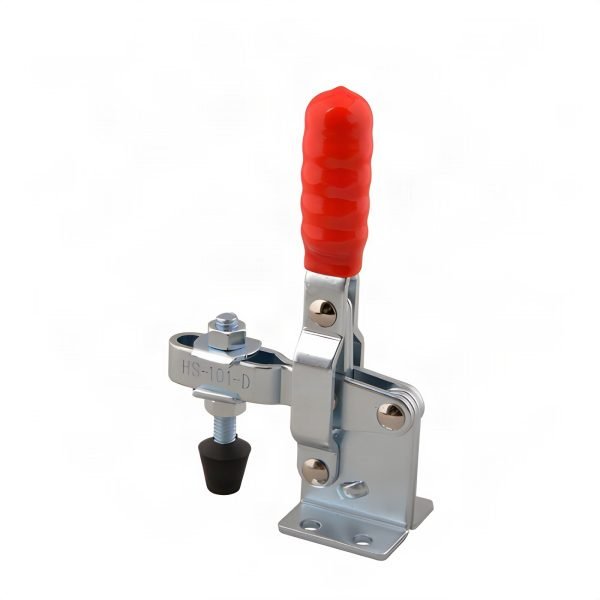
Toggle clamps for welding fixtures: how to choose them
Torch access, distortion, spatter: how to choose the toggle clamps of a welding fixture, with the families and holding capacities of the catalogue.
Read the article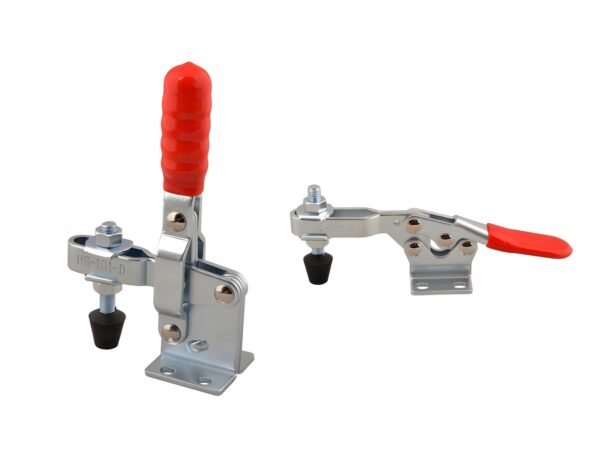
Vertical vs horizontal toggle clamp: differences and how to choose
Handle position, clearance, ergonomics and base type: the real differences between vertical and horizontal toggle clamps, and the questions to ask before choosing.
Read the article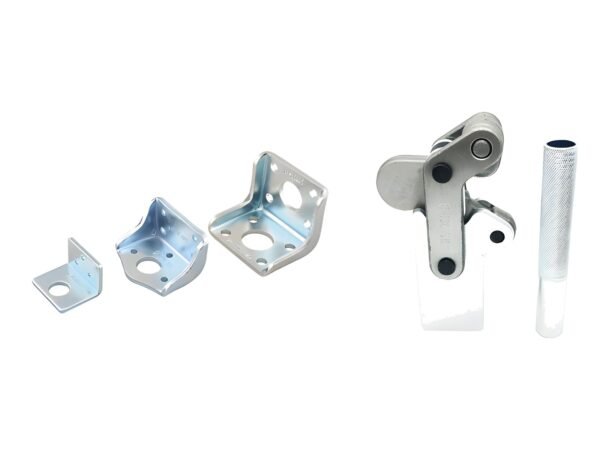
Choosing the right toggle clamp accessories
Spindles, pressure pads, rods, mounting: the role of accessories in a clamping system, the compatibility points to check and the mistakes to avoid.
Read the article