
Toggle clamps for welding fixtures: how to choose them
Torch access, distortion, spatter: how to choose the toggle clamps of a welding fixture, with the families and holding capacities of the catalogue.
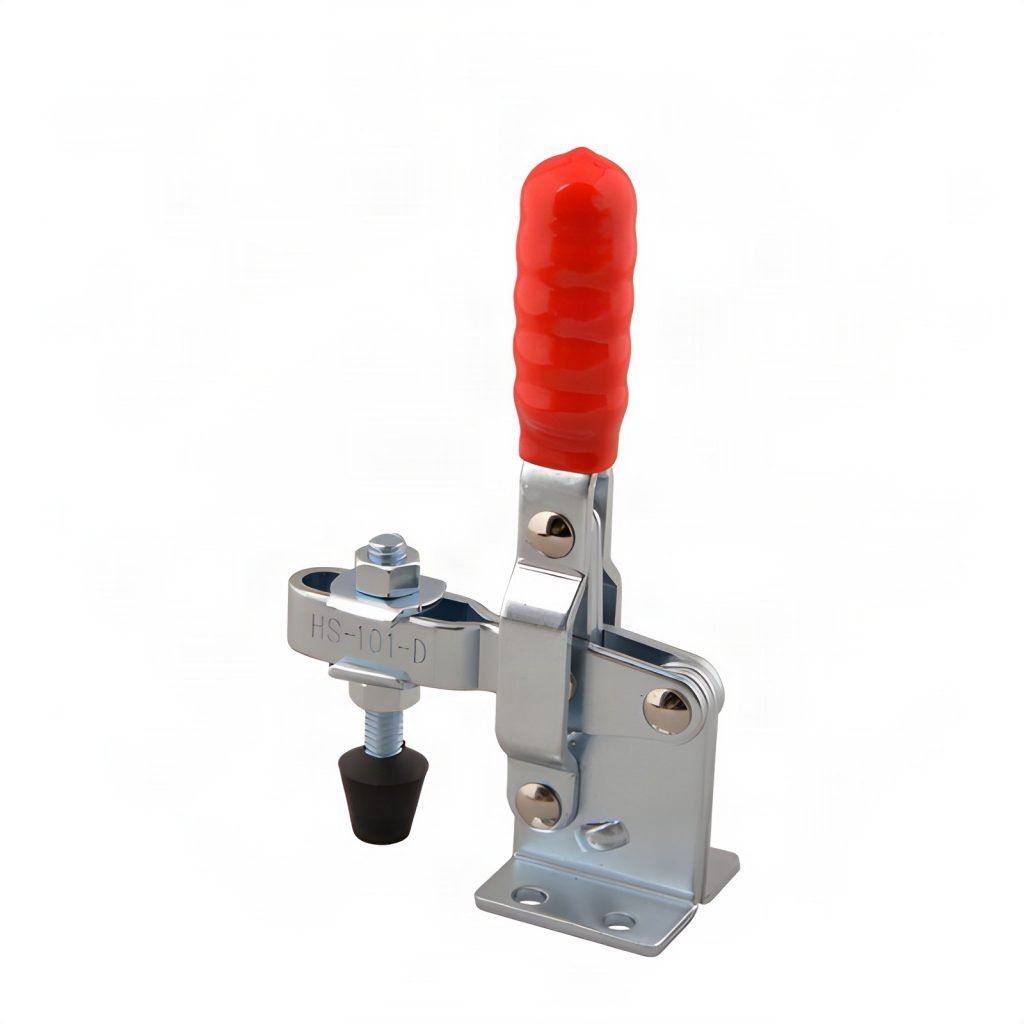
On a welding fixture, the toggle clamp holds the parts in their reference position during tacking and welding, then releases them in one movement. The right model mainly depends on the direction of the force, the room left for the torch and the load the clamp must hold while the parts distort under heat.
This guide reviews the constraints specific to welding, the toggle clamp families that suit each situation and the points to check before choosing. For how a toggle clamp works in general, see our guide Understanding the different types of toggle clamps.
What welding demands from clamping
- Torch access. The clamp, its arm and its handle must not get in the way of the torch or of the welder’s view of the joint.
- Distortion. As they cool, the parts shrink and can pull on the clamping point: the clamp must hold this load without opening.
- Spatter. It can settle on the spindle and its threads: place the clamp outside the spatter zone when possible and check the spindle and the pressure pad regularly.
- Repeatability. From one part to the next, clamping must bring each element back against the same locating points, without adjustment.
Which family for which situation?
| Situation on the fixture | Family to look at | Catalogue range |
|---|---|---|
| Press a part onto the table, with clearance above to load and unload | Vertical toggle clamps | 78 models, from 30 to 550 kg |
| Press a part when the height is limited or the handle must stay clear of the torch | Horizontal toggle clamps | 60 models, from 20 to 636 kg |
| Push a part against a stop or a square, along an axis | Push-pull toggle clamps | 46 models, from 45 to 2500 kg |
| Draw two parts of a fixture or an assembly together and lock them | Latch toggle clamps | 21 models, from 163 to 3400 kg |
The values are the holding capacities listed on the product pages (catalogue data at the time of writing). On the same fixture it is common to combine several families: vertical clamps to press the parts onto the table and push-pull clamps to push them against the stops.
Choosing the holding capacity
Holding capacity is the load the closed clamp can withstand; it is not the force it applies to the part. On a welding fixture, take into account the loads caused by distortion and the position of the clamping point on the arm, and keep a margin. Start from the actual loads on the fixture (weight and movement of the parts, shrinkage as they cool, handling forces), take the fixture configuration into account (number of clamps sharing the load, direction of the force relative to the arm) and check the chosen value against the manufacturer’s documentation for the model. Our guide Toggle clamp holding capacity explains the method.
Example models from the catalogue
- Vertical toggle clamp 101-J: holding capacity of 550 kg, the top of the vertical range.
- Horizontal toggle clamp 204-G: 636 kg, to press parts with a low overall height.
- Push-pull toggle clamp 30608M: 318 kg, to push a part against a stop.
- Latch toggle clamp 40334: 450 kg, to lock two elements together.
Each product page lists the characteristics of the model (holding capacity, weight, openings and surface treatment depending on the reference): compare them with your measurements before choosing.
Mistakes to avoid
- Placing the clamping point in the path of the torch or in the spatter cone.
- Choosing the capacity without allowing for distortion as the parts cool.
- Forgetting the room the open handle needs to load and unload the parts.
- Letting spatter build up on the spindle, which eventually upsets the setting.
FAQ
Vertical or horizontal on a welding fixture?
Vertical when there is clearance above the fixture and the loading area must be fully cleared; horizontal when the height is limited or the handle would get in the way of the torch. Our guide How to choose an industrial toggle clamp covers the selection criteria.
How many toggle clamps does a fixture need?
As many as there are locating points needed to hold each part against its references so that it cannot move. The number depends on the shape of the parts and the welding sequence: it is decided on the fixture drawing.
Need help equipping your fixture?
For an accurate answer, include with your quote request:
- the drawing or a photo of the fixture;
- the parts to hold (dimensions and material);
- the planned clamping points and the direction of the force;
- the quantities;
- any references already used or considered.
We will help you choose the right models from our toggle clamp catalogue. Request a quote.
Need help choosing?
Browse the catalogue or tell us about your application: we reply within 24 working hours.
Read also
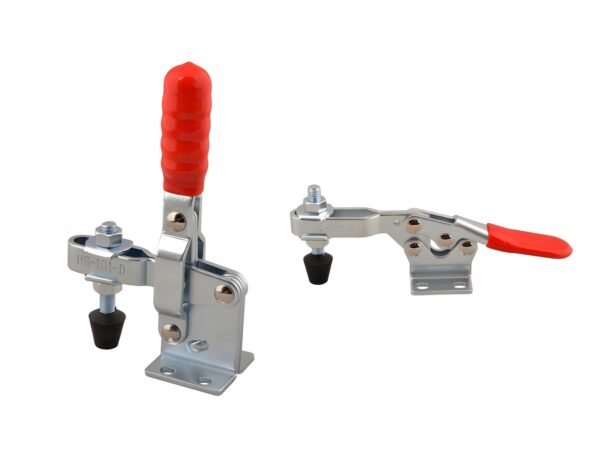
Vertical vs horizontal toggle clamp: differences and how to choose
Handle position, clearance, ergonomics and base type: the real differences between vertical and horizontal toggle clamps, and the questions to ask before choosing.
Read the article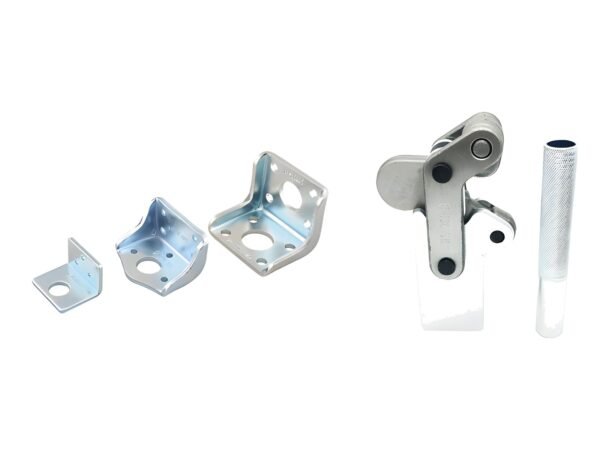
Choosing the right toggle clamp accessories
Spindles, pressure pads, rods, mounting: the role of accessories in a clamping system, the compatibility points to check and the mistakes to avoid.
Read the article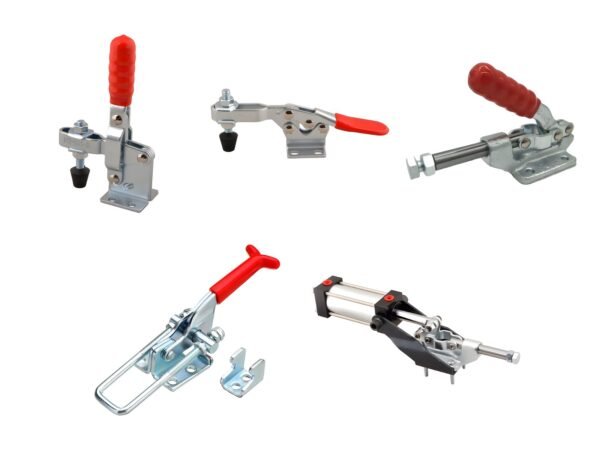
Understanding the different types of toggle clamps
Vertical, horizontal, push-pull, latch and pneumatic: the five families of toggle clamps, how they differ in use and the questions to ask before choosing.
Read the article