
Understanding the different types of toggle clamps
Vertical, horizontal, push-pull, latch and pneumatic: the five families of toggle clamps, how they differ in use and the questions to ask before choosing.
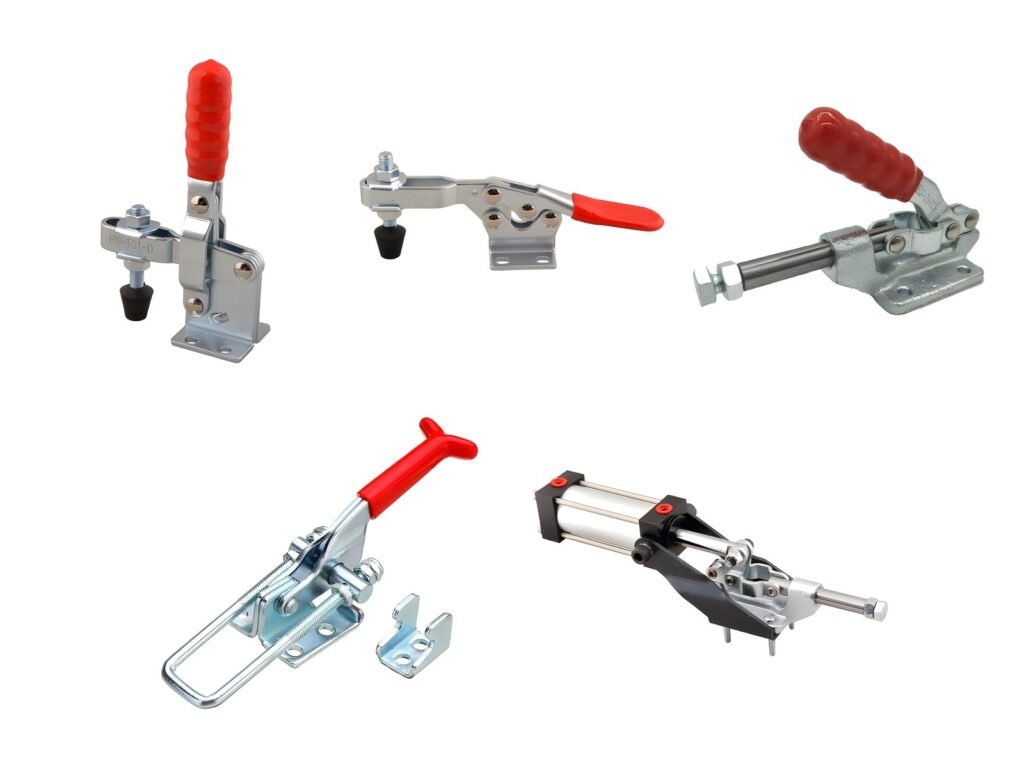
A toggle clamp holds a workpiece in position during machining, welding, assembly or inspection. Yet not all toggle clamps have the same motion or take up the same space: the right model depends on how the workpiece must be held and how much room there is on the fixture.
This guide explains how a toggle clamp works, then presents the five main families in the GOGO INDUSTRY catalogue and how they differ in use. For the method to choose a model, see our guide How to choose an industrial toggle clamp.
How does a toggle clamp work?
A toggle clamp works on the toggle principle: the handle drives a set of pivoting links which, at the end of their travel, move slightly past the point where their pivots line up (the “dead centre”). Once past that point, the load of the workpiece on the arm tends to keep the clamp closed rather than open it: the clamp stays locked without the operator holding the handle.
This locking is what holds a workpiece in a repeatable way during machining, welding or assembly. It also explains the difference between clamping force (the force applied to the workpiece when the clamp closes) and holding capacity (the force the closed clamp can withstand): see our guide Toggle clamp holding capacity.
The families below all use this principle; they differ in the motion transmitted to the workpiece (an arm that comes down, a plunger that moves forward, a hook that pulls) and in the position of the handle. Pneumatic toggle clamps replace the manual handle with an air cylinder. For a detailed technical presentation, see the Carr Lane Manufacturing engineering resources.
Vertical toggle clamps
On a vertical toggle clamp, the handle moves in a vertical plane. When open, it leaves the work area largely clear, which makes it easy to load and unload the workpiece.
It is often the first choice for a jig or a production fixture, provided there is enough height above the fixture: the raised handle must be able to swing without getting in the way of the operator or other elements.
Horizontal toggle clamps
On a horizontal toggle clamp, the handle lies flat in the closed position, so the overall height is reduced.
This type suits applications with limited space above the fixture, for example under a tool, inside a frame, or when several fixtures are stacked or placed close together. You do, however, need room in front of or behind the clamp to operate the handle.
Push-pull toggle clamps
On a push-pull toggle clamp, a plunger moves in a straight line to push or pull the workpiece.
This linear motion is useful when the force must be applied along an axis: pressing a workpiece against a stop, pushing it towards a locating point or pulling a fixture element. The choice mainly depends on the plunger stroke, the working direction (push, pull or both) and the mounting method.
Latch toggle clamps
On a latch toggle clamp, a hook pulls two parts together and locks them.
They are used when two elements have to be closed, drawn together or held together: lids, hatches, boxes, two-part jigs. Check the position of the catch plate and the hook travel so that the clamp locks without forcing.
Pneumatic toggle clamps
Pneumatic toggle clamps are operated by compressed air instead of a manual handle.
They are mainly of interest for workstations with many clamping cycles or for automated stations. Choosing one requires checking the operating pressure, the available force, the air connections and the safety rules of the installation in the model’s documentation.
Summary table
| Family | Motion | Point to check | Typical use |
|---|---|---|---|
| Vertical | Handle moved in a vertical plane | Height needed with the handle open | Jig or production fixture with clearance above |
| Horizontal | Handle flat in the closed position | Room to operate the handle | Limited height above the fixture |
| Push-pull | Plunger moving in a straight line (push and / or pull) | Stroke and working direction | Pressing a workpiece against a stop, force along an axis |
| Latch | Hook that pulls and locks | Catch plate position, hook travel | Closing or drawing two elements together |
| Pneumatic | Compressed-air actuation | Pressure, connections, safety | Many cycles, automated station |
How to choose between these families
A few simple questions guide the choice:
- In which direction must the force be applied? Down onto the workpiece: vertical or horizontal. Along an axis: push-pull. To draw two elements together: latch.
- How much space is left around the fixture? Little height: horizontal. The work area must be fully cleared: vertical.
- How many clamping cycles per day? For a very high number of cycles or an automated station, the pneumatic version is worth considering.
- What load must be held? Compare the holding capacity listed on the model’s product page with the actual loads of the operation, and ask for advice if in doubt. Our guide Toggle clamp holding capacity explains how to read this value.
Not sure whether you need a vertical or a horizontal toggle clamp? Our guide Vertical vs horizontal toggle clamp: differences and how to choose compares the two families point by point.
For more on these criteria (application, available space, duty cycle), see also our guide How to choose an industrial toggle clamp.
FAQ
Why does a toggle clamp stay closed on its own?
Because its links move slightly past the dead centre when it closes: the load of the workpiece on the arm then tends to keep it closed rather than open it. See “How does a toggle clamp work?” above.
When should I choose a push-pull toggle clamp?
When the force must be applied along an axis, for example to press a workpiece against a stop or to pull a fixture element. Check the plunger stroke and the working direction.
Finding the right model
Each family includes many references, each with its own characteristics (holding capacity, weight, arm and handle opening, surface treatment, depending on the model). Browse the GOGO INDUSTRY catalogue to compare models, or request a quote with your application: our team will help you identify the right reference.
Need help choosing?
Browse the catalogue or tell us about your application: we reply within 24 working hours.
Read also
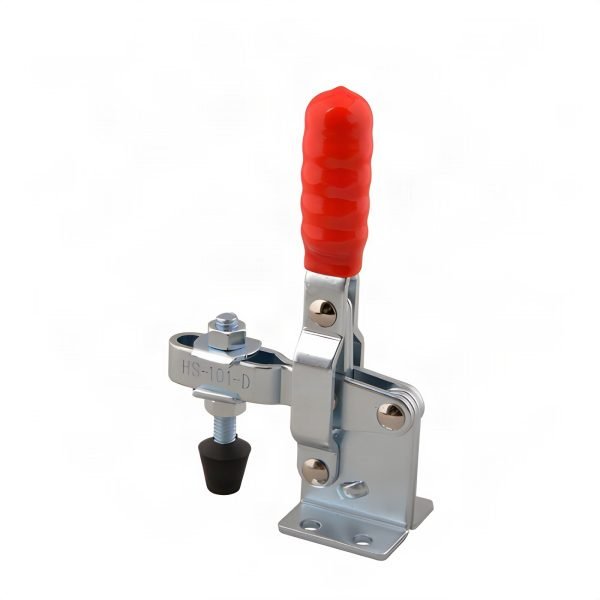
Toggle clamps for welding fixtures: how to choose them
Torch access, distortion, spatter: how to choose the toggle clamps of a welding fixture, with the families and holding capacities of the catalogue.
Read the article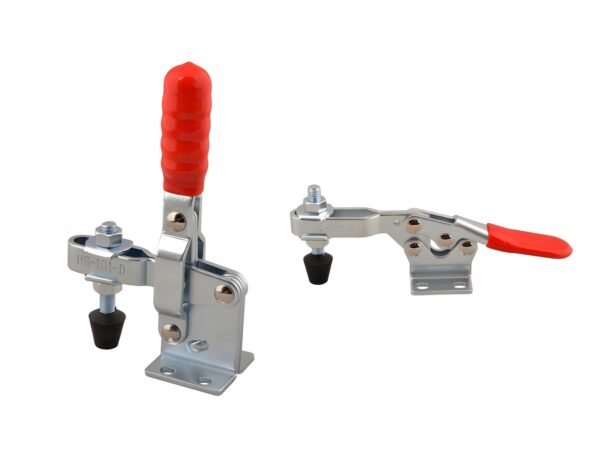
Vertical vs horizontal toggle clamp: differences and how to choose
Handle position, clearance, ergonomics and base type: the real differences between vertical and horizontal toggle clamps, and the questions to ask before choosing.
Read the article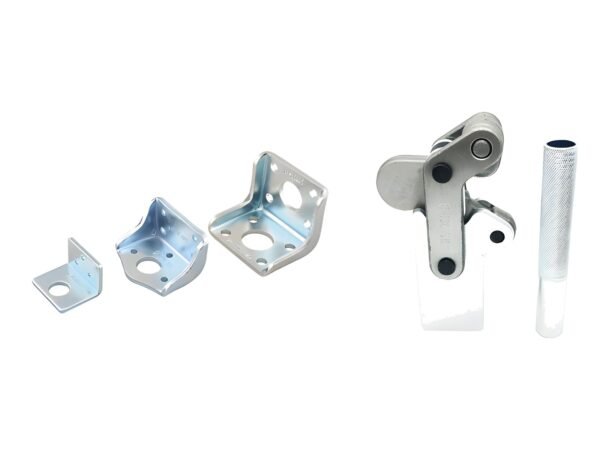
Choosing the right toggle clamp accessories
Spindles, pressure pads, rods, mounting: the role of accessories in a clamping system, the compatibility points to check and the mistakes to avoid.
Read the article