
Vertical vs horizontal toggle clamp: differences and how to choose
Handle position, clearance, ergonomics and base type: the real differences between vertical and horizontal toggle clamps, and the questions to ask before choosing.
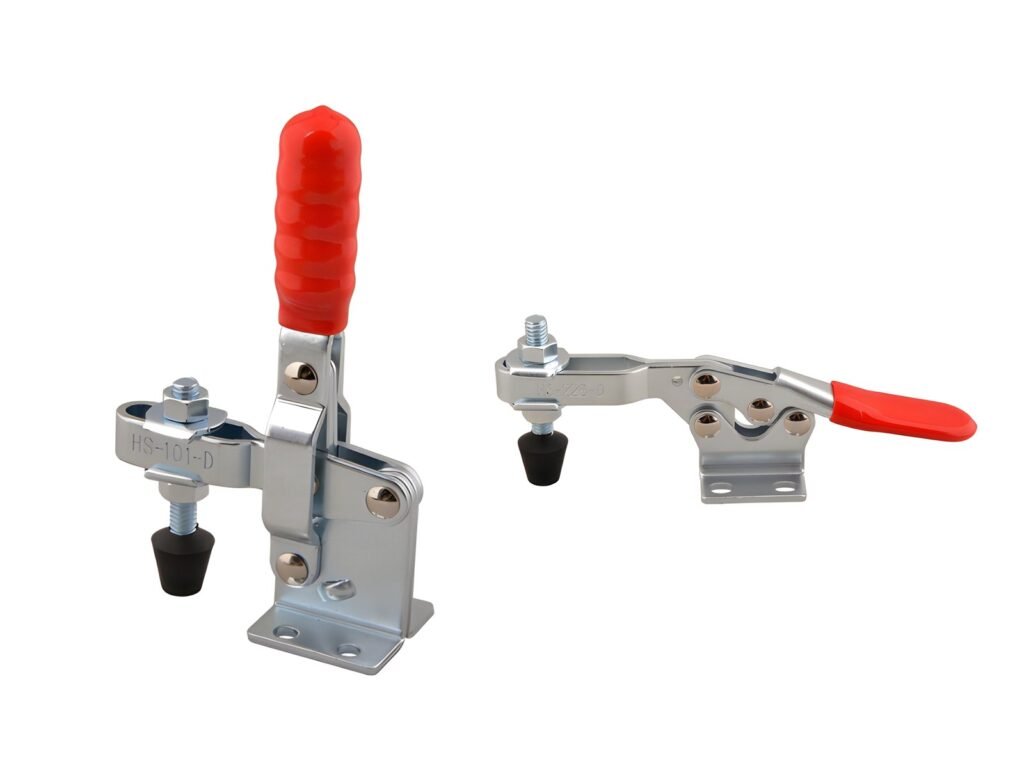
Vertical and horizontal toggle clamps are the two families most often found on jigs, welding fixtures and assembly stations. They do the same job: press a workpiece down and hold it during an operation. What sets them apart is the position of the handle, and therefore the space they take up on the fixture. This guide compares the two families point by point and gives you the criteria to choose, based on the data published on GOGO INDUSTRY product pages.
What is the difference between a vertical and a horizontal toggle clamp?
Handle position when the clamp is closed
The difference is in the handle once the clamp is locked:
- on a vertical toggle clamp, the handle stays upright when the clamp is closed;
- on a horizontal toggle clamp, the handle lies flat when the clamp is closed.
This is how manufacturers who document it define the two types, DESTACO among them [1]. The family name refers to the handle position, not to the direction of the force on the workpiece.
Two hold-down clamps that work the same way
Both are hold-down clamps: the arm comes down on the workpiece and presses it against its support, with an adjustable spindle making the contact. Carr Lane lists both under the same hold-down category, with a horizontal or a vertical handle [2]. The mechanism locks in the closed position in the same way, so choosing between the two is first a matter of space and access at the workstation, not of working principle.
Handle position vs base type: two different things
Catalogues also use “vertical” and “horizontal” for the base, the part that mounts the clamp to the fixture. Some manufacturers list references such as a “vertical clamp with horizontal base”: the first word describes the handle, the second the base.
On GOGO INDUSTRY product pages, the base type is given for some models only:
- “Straight base” (“Base droite”): 4 vertical clamps (e.g. 101-DI, 12145) and 6 horizontal clamps (e.g. 21800, 22384);
- “Flanged base” (“Bride”): 2 vertical clamps (13007SM, 12050-U60) and 3 horizontal clamps (20100, 25382, 204-GB).
For the other models, the product page does not state the base type. If the mounting matters for your fixture (vertical support, little room for screws), ask us to confirm the base type before ordering.
Clearance: where does the handle go?
This is the criterion that most often decides.
- Vertical toggle clamp: the upright handle needs height above the fixture but little room around the clamp. DESTACO recommends it where horizontal space is limited and vertical space is available [1].
- Horizontal toggle clamp: the handle stays low when the clamp is closed. It suits applications with limited overhead clearance, such as under a tool, inside a frame or on fixtures placed close together [1]. You do need room in front of or behind the clamp to operate the handle.
In both cases, check the space needed with the handle open and closed, and the arm travel: a handle that hits another part of the fixture or gets in the operator’s way makes the station unusable, whatever the clamp’s capacity.
Ergonomics and access to the workpiece
- The operator’s movement: DESTACO advises choosing the family whose handle motion is most natural for the operator at that station [1]. A vertical handle is pulled back and forth; a horizontal handle is folded down flat.
- Clearing the work area: when open, the arm must clear the workpiece enough to load and unload it. GOGO INDUSTRY product pages give the arm opening and the handle opening of each model in degrees: compare them with the space on your fixture.
- Cycle rate: on a station where parts are loaded and unloaded often, a simple movement and good clearance save time on every cycle.
Comparison table
| Criterion | Vertical toggle clamp | Horizontal toggle clamp |
|---|---|---|
| Handle when closed | Upright | Flat |
| Clearance | Needs height above the fixture | Stays low; needs room in front or behind |
| Typical situation | Height available, little room around the clamp | Limited height: under a tool, inside a frame, fixtures close together |
| Operator movement | Handle pulled back and forth | Handle folded down flat |
| Function | Hold-down clamp: the arm presses the workpiece | Hold-down clamp: the arm presses the workpiece |
| Base type (GOGO product pages) | Straight or flanged base stated for 6 models | Straight or flanged base stated for 9 models |
| Listed holding capacity (GOGO catalogue) | 30 to 550 kg (77 models) | 20 to 636 kg (59 models) |
What GOGO INDUSTRY product pages show
The GOGO INDUSTRY catalogue includes 78 vertical and 60 horizontal toggle clamp product pages (catalogue data as of 16 November 2026). The listed values overlap widely: holding capacity depends on the model, not on the family.
| Vertical toggle clamps | Horizontal toggle clamps | |
|---|---|---|
| Listed holding capacity | 30 to 550 kg | 20 to 636 kg |
| Listed arm opening | 80° to 140° (100° on about half of the pages) | 55° to 185° (most often 85° to 90°) |
| Listed handle opening | 45° to 170° | 50° to 94° |
A few examples:
- Vertical toggle clamp 13009: holding capacity 30 kg, weight 45 g, arm opening 80°;
- Vertical toggle clamp 101-D: 180 kg, 345 g, arm opening 100°, handle opening 60°;
- Vertical toggle clamp 101-JS: 550 kg, 2,540 g;
- Horizontal toggle clamp 20100: 20 kg, 35 g, flanged base;
- Horizontal toggle clamp 225-D: 227 kg, 260 g, arm opening 90°;
- Horizontal toggle clamp 204-GL: 636 kg, 1,305 g.
The listed holding capacity is the force the closed clamp can withstand. It is neither the clamping force applied to the workpiece nor a lifting capacity, and a toggle clamp must never be used to lift or suspend a load. To read and compare these values, see our guide Toggle clamp holding capacity.
Industrial application examples
| Situation | Family often chosen | Why |
|---|---|---|
| Welding jig on a table with room above | Vertical | The upright handle is not in the way; the open arm clears the area for loading |
| Fixture under a tool, a press or inside a frame | Horizontal | The flat handle stays within the available height |
| Several fixtures close together or stacked | Horizontal | Lower overall height |
| Assembly or inspection station with frequent loading | Whichever movement is most natural at the station | Ergonomics and clearance come first |
| Industrial woodworking | Both families | Depending on the space; several GOGO product pages list this use |
Many GOGO INDUSTRY product pages, in both families, list welding, assembly, fixtures and jigs as uses, and some list woodworking. These indications guide the choice; they do not replace checking the space and the loads at your station.
How to choose in 5 questions
- How much height is left above the fixture, with the handle open and closed? Little height: horizontal. Height available and little room around: vertical.
- Where does the operator stand, and which movement is most natural? Choose the family whose handle motion is simplest at that station.
- Does the open arm clear the workpiece enough? Compare the arm opening on the product page with the room needed to load and unload the part.
- What holding capacity is needed? Estimate the loads of the operation and compare them with the capacity on the product page, with a margin (see our guide on holding capacity).
- How will the clamp be mounted? Check the base type and the room for screws; if the product page does not state the base, ask us.
For the other criteria (application, stroke, duty cycle, environment), see also How to choose an industrial toggle clamp. If your fixture needs another motion (pushing along an axis, latching), see the other families in Understanding the different types of toggle clamps.
Mistakes to avoid
- Confusing handle position with base type: “vertical” or “horizontal” in the family name describes the handle; the base is a separate characteristic.
- Checking the clearance with the handle closed only: the open handle and the raised arm take up space too.
- Choosing the family by capacity: the listed capacities of the two families overlap; the model is what matters.
- Confusing holding capacity, clamping force and lifting capacity: the listed capacity is the force the closed clamp withstands, not a load to lift.
- Ignoring the clamping point: for manufacturers who document it, holding capacity is lower when the spindle is further from the base [2].
FAQ
What is the difference between a vertical and a horizontal toggle clamp?
The handle position once the clamp is closed: upright on a vertical clamp, flat on a horizontal one. Both are hold-down clamps; the choice mainly depends on the available space and the operator’s movement.
Is a vertical toggle clamp stronger than a horizontal one?
Not as a rule. In the GOGO INDUSTRY catalogue, listed holding capacities range from 30 to 550 kg for vertical clamps and from 20 to 636 kg for horizontal clamps: compare models, not families.
Which toggle clamp needs the least height?
The horizontal toggle clamp, whose handle stays flat when closed. Plan room in front of or behind it to operate the handle.
Does “horizontal base” mean a horizontal toggle clamp?
No. The base is the mounting part. A clamp can, for example, have a vertical handle and a horizontal base. On GOGO INDUSTRY product pages, the base type is stated for some models (straight or flanged base); for the others, ask us.
Can a 180 kg toggle clamp lift 180 kg?
No. Holding capacity is the force the closed clamp can withstand on a fixture. It is not a lifting capacity: a toggle clamp is never used to lift or suspend a load.
Need help choosing?
Browse our vertical toggle clamps and horizontal toggle clamps, or the full product catalogue. Tell us the available space, the estimated load and your application: we will help you identify the right model, with a price quoted for your quantities. Request a quote (reply within 24 working hours).
Sources
[1] DESTACO, “Vertical Versus Horizontal Clamps” — https://www.destaco.com/resources/blogs-and-insights/vertical-versus-horizontal-clamps (accessed 16 November 2026).
[2] Carr Lane Manufacturing, “Toggle Clamps” and “Holding Capacity & Clamping Force” — https://www.carrlane.com/engineering-resources/technical-information/manual-workholding/toggle-clamps (accessed 16 November 2026).
Need help choosing?
Browse the catalogue or tell us about your application: we reply within 24 working hours.
Read also
Toggle clamps for welding fixtures: how to choose them
Torch access, distortion, spatter: how to choose the toggle clamps of a welding fixture, with the families and holding capacities of the catalogue.
Read the article
Choosing the right toggle clamp accessories
Spindles, pressure pads, rods, mounting: the role of accessories in a clamping system, the compatibility points to check and the mistakes to avoid.
Read the article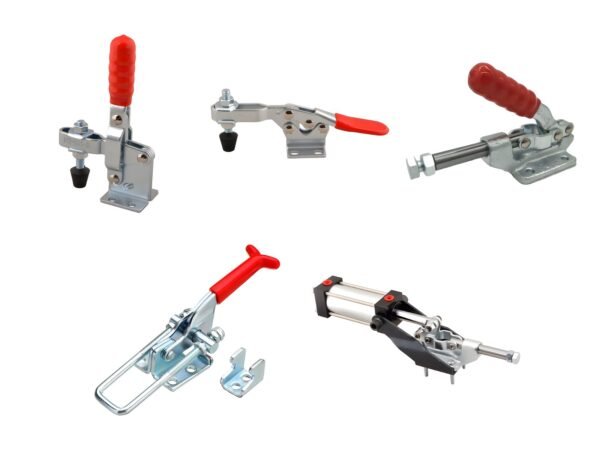
Understanding the different types of toggle clamps
Vertical, horizontal, push-pull, latch and pneumatic: the five families of toggle clamps, how they differ in use and the questions to ask before choosing.
Read the article